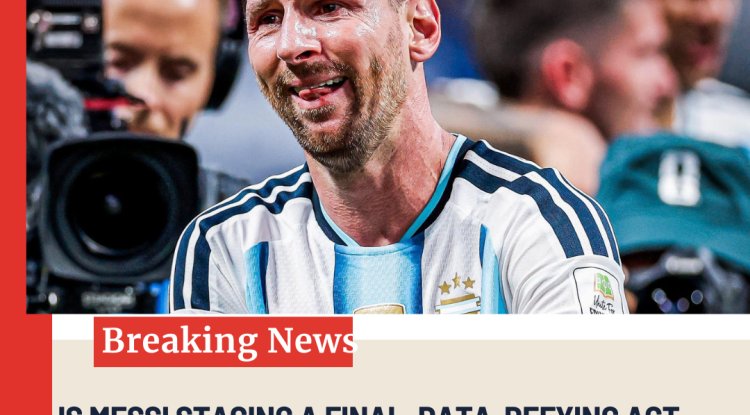
How advanced data proves Lionel Messi defies football logic.

By Sandra Kenneth
18\07\2026
Football is, by design, a beautifully chaotic calculations nightmare. On any given matchday, data firms track millions of coordinates per second, mapping 22 players and a volatile ball interacting with the human foot. It is a sport so inherently unpredictable that fans routinely abandon logic, choosing instead to credit the divine for what they see on the pitch.
Then there is Lionel Messi. For two decades, the Argentine maestro has achieved the impossible by making the world's most complex game look absurdly simple.
Yet, as the 2026 World Cup loomed, a quiet skepticism began to take root in the footballing world. Cynics argued that the magic had finally waned. He was 38 at kick-off, turning 39 midway through the tournament. His previous four years were spent in Major League Soccer—a notable step down from European standard—and his output at the 2024 Copa América yielded just a solitary goal before an injury forced him to watch his teammates win the trophy without him in extra time.
The consensus seemed settled: Messi arrived in North America to be a luxury fringe contributor, a nostalgic figurehead expected to provide fleeting moments of brilliance rather than carry a nation.
Instead, he blew the script apart.
THE THREE FACES OF MESSI
How one man dominated the modern era:
┌──────────────────────────────────────┐
│  GOAL SCORING:     Tied w/ Ronaldo   │
├──────────────────────────────────────┤
│  CHANCE CREATION:  Stands Alone      │
├──────────────────────────────────────┤
│  BALL PROGRESSION: Best of His Class │
└──────────────────────────────────────┘
Source: Data Analysis / Michael Caley
The numbers compiled this summer by sports analysts don't just defend Messi against the "overhyped" narrative; they mathematically isolate him as an unprecedented anomaly.
In elite football, tactical success is divided into three distinct phases: advancing the ball up the pitch, carving open the final third, and converting the chance. Traditional superstars excel at one, perhaps two, of these disciplines. Peak Messi was simultaneously the world’s best ball progressor, its most lethal playmaker, and its most devastating finisher. He wasn't merely the finest player of his generation; statistically, he functioned as the three best players of his era combined.
While it is true he no longer operates at the terrifying zenith of his Barcelona days—when he manufactured a staggering 96 goals and 27 assists across a two-year stretch—the 39-year-old version remains peerless.
As the tournament enters its decisive phase, Messi sits tied with France's Kylian Mbappé at the top of the Golden Boot standings with eight goals. This is no statistical fluke or fortunate streak of clinical finishing. The data confirms he has earned every bit of his tally, leading the entire World Cup field with 34 shots attempted.
Four years ago, debating the title of the greatest male athlete in history required a degree of nuance. After the events of this summer, the data has rendered the argument obsolete. Lionel Messi isn't just surviving at the highest level at age 39; he is still dictating it.
What's Your Reaction?